


GridProof your UI — automated spacing & grid QA in the agent loop.
GridProof is an MCP server that renders your running frontend with Playwright, measures the computed geometry of every element, checks it against a spacing/token rule set, and hands back a structured fix report — so a coding agent can close the loop itself: generate, audit, fix, re-audit.
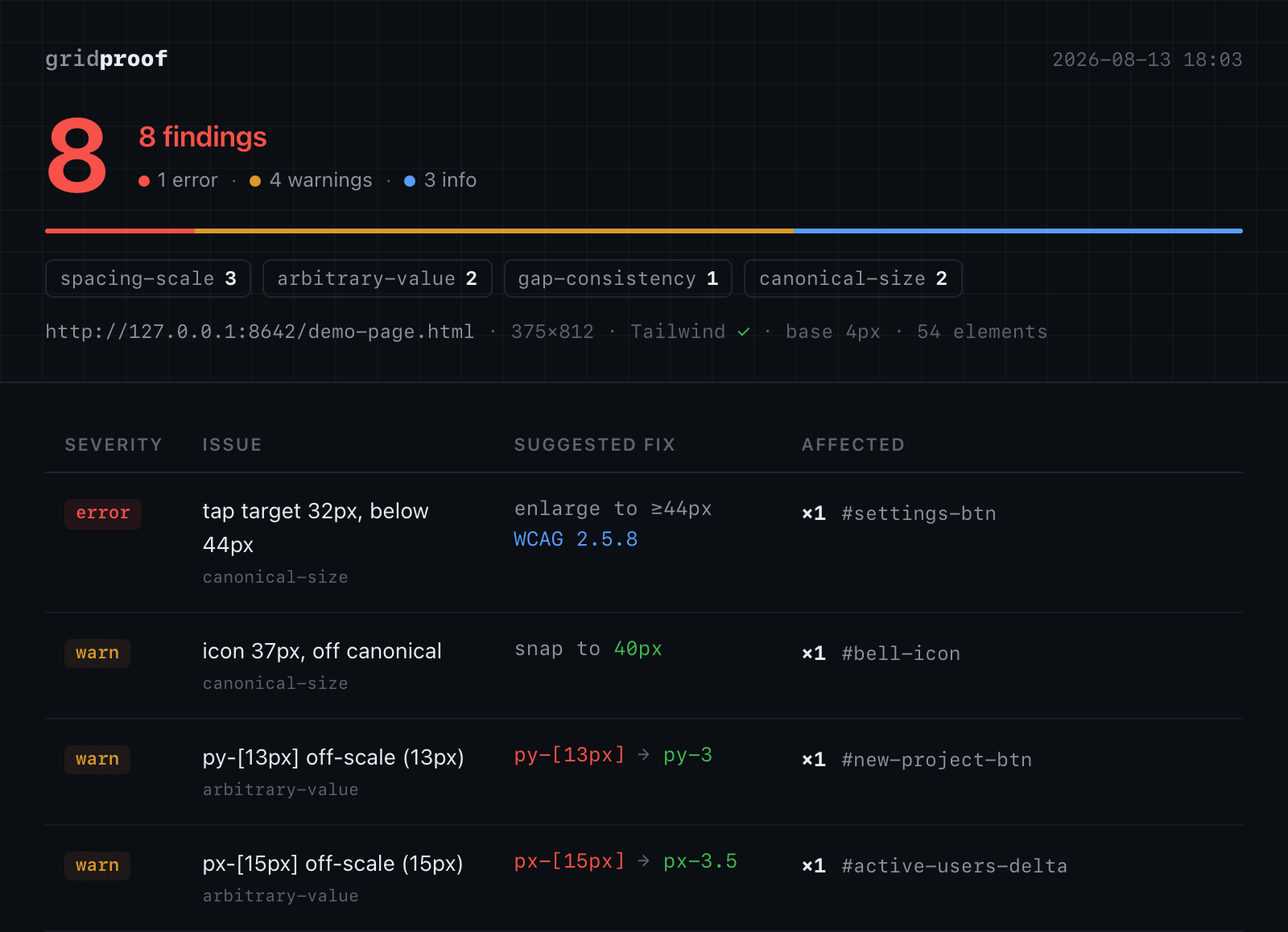
AI coding agents are good at generating UI and bad at keeping it on a grid:
py-[13px] instead of py-3, sibling cards with three different gaps,
icons at 17px next to 24px. None of it breaks anything, so it ships —
because nothing in the agent loop checks for it. GridProof is that check.
agent generates UI → gp_audit(url) → JSON violations with fix hints
→ agent edits source → gp_audit(url) → clean report = done
The server never touches your source files. It measures a rendered page and points; the agent (which has your codebase open) makes the edit.
# One-time: install the Chromium build Playwright uses (~150MB)
npx playwright install chromiumclaude mcp add gridproof -- npx -y gridproofFrom a local checkout:
npm install && npm run build
claude mcp add gridproof -- node /absolute/path/to/gridproof/dist/index.js1. gp_audit — inside the agent loop. The agent calls this MCP tool
directly against your running dev server and gets back structured JSON
(violations + fix hints) to act on.
2. gp_report — MCP tool that also writes an HTML report. Same inputs as
gp_audit, plus it writes a self-contained, shareable HTML file to disk.
3. npx gridproof --report <url> — one-shot CLI. No MCP client needed;
useful for a quick manual check or scripting.
npx gridproof --report http://localhost:5173
# writes ./gridproof-report.html, prints its path

npx gridproof --report http://localhost:5173 --out ./qa/report.html --viewport 375x812Four rules. All report warn by default — nothing blocks, nothing has
exit-code semantics. Suggest, don't forbid; the one exception is tap
targets, which error because it's an accessibility floor, not a style opinion.
| Rule | Detects | Severity | Example fix |
|---|---|---|---|
spacing-scale |
Computed margin/padding/gap that isn't a multiple of the base unit (default 4px) and isn't an allowed value | warn | Snaps to the nearest valid value |
arbitrary-value |
Off-scale arbitrary Tailwind classes | warn | py-[13px] → py-3 |
gap-consistency |
Siblings in a flex/grid container spaced inconsistently when gap isn't set |
warn | Set gap-4 on the container instead of per-child margins |
canonical-size |
Icon/interactive-element sizes off the canonical scale, and interactive elements below the tap-target minimum | warn (icons) / error (tap targets) | Snap to canonical size; WCAG 2.5.8 |
GridProof is built for Tailwind projects — that's where all four rules apply,
since spacing-scale, arbitrary-value, and gap-consistency reason about
Tailwind's spacing scale and utility classes.
On a page it doesn't detect as Tailwind, it auto-falls-back to
accessibility-only checks: canonical-size still runs (tap targets, icon
sizes), the three Tailwind-specific rules are skipped, and the report says so
explicitly rather than silently under-reporting. You can force this with
assumeTailwind: false in config.
Optional gridproof.config.json at your project root (all fields optional;
defaults shown):
{
  "baseUnit": 4,
  "allowedValues": [1, 2],
  "canonicalSizes": [12, 14, 16, 20, 24, 32, 40, 48],
  "minTapTarget": 44,
  "tapTargetBreakpoint": 768,
  "iconTolerance": 2,
  "assumeTailwind": "auto",
  "rules": {
    "spacing-scale": "warn",
    "arbitrary-value": "warn",
    "gap-consistency": "warn",
    "canonical-size": "error"
  },
  "suppress": [
    { "selector": ".hero-art *", "rules": ["spacing-scale"] },
    { "value": "13px", "reason": "optical correction, logo lockup" }
  ]
}
Inline suppression: data-gp-ignore (all rules) or
data-gp-ignore="spacing-scale gap-consistency" on any element skips its
subtree for those rules. Suppressed findings are counted, never listed.
- No computer vision / screenshot analysis. It reads computed geometry, not pixels. A screenshot is attached to the HTML report, not analyzed.
- No CI runner. It's an in-loop tool for an agent, not a merge gate — no exit codes, nothing fails a build.
- No source editing. The server measures and suggests; the agent (which has your codebase) makes the edits.
- No auth, no SaaS, no billing. It's a local MCP server and a CLI.
- Not yet (v2 candidates, not implemented): column-grid clustering, cross-breakpoint alignment drift, Figma token import.
Playwright renders the target page headless, a single in-page script walks the DOM and collects computed geometry (margins, padding, gap, rects), and the rule engine checks each value against your config and emits violations with selectors, actual/expected values, and fix hints. It's tuned against roughly 60 real-world sites to keep false positives low — a subpixel rounding tolerance, an allowed-values list, and severity defaults all come out of that calibration, not guesswork.
npm install
npm run build   # tsc → dist/
npm test        # vitest (unit + Playwright integration)
npm run dev # run the server from TypeScript (tsx)MIT — v0.1.0