

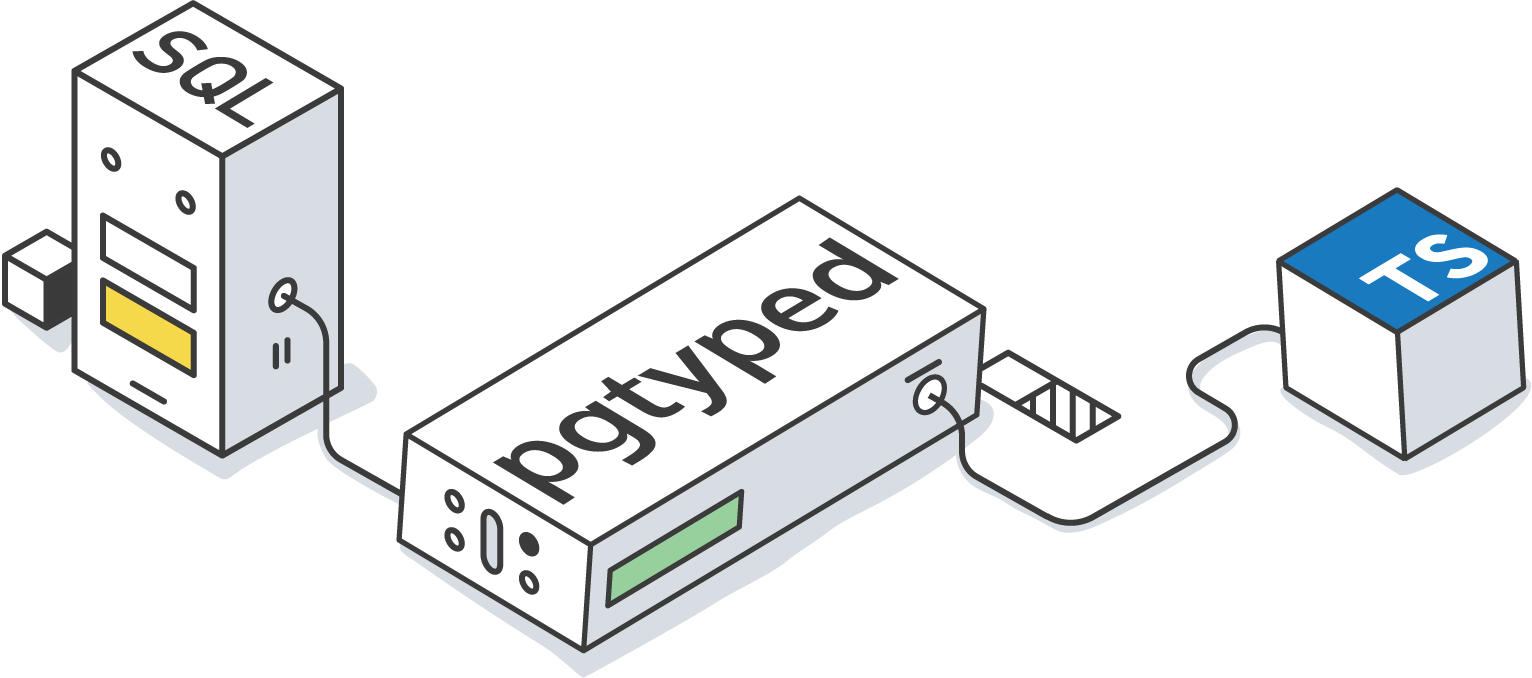

Write SQL. Get TypeScript types for it, taken from your real database.
PgTyped reads the queries in your .sql files (or sql tags in .ts files), asks Postgres what each one takes and returns, and writes a typed function for it. Your schema stays where it already is — in the database. There is nothing to keep in sync by hand.
- Types for parameters and results, inferred from the live schema. Change a column, regenerate, and the compiler tells you what broke.
- Queries in plain SQL files, or inline
sqltags in TypeScript. Both are typed the same way. - Parameters are sent to Postgres separately from the query text, so there is no string substitution and no SQL injection surface.
- Every fixed query is sent as a named prepared statement, so Postgres parses and plans it once per connection.
- A runtime with no dependencies of its own.
- Watch mode, so types regenerate as you edit.
- Codegen with no server at all: hand it an in-process PGlite and the whole pipeline runs inside your Node process. See below.
- Optional checks that catch problems before runtime: a query the connecting role may not execute, a parameter you forgot to pass, a name that hides a typo.
The packages are published to GitHub Packages, not to npmjs.com. Two things are needed first, and both are easy to miss:
-
Tell npm where the
@pelotechscope lives. In your project's.npmrc:@pelotech:registry=https://npm.pkg.github.com //npm.pkg.github.com/:_authToken=${GITHUB_TOKEN} -
GITHUB_TOKENmust be a token with theread:packagesscope. GitHub Packages needs one to install even public packages.
Then:
npm install -D @pelotech/pgtyped-cli
npm install @pelotech/pgtyped-runtime
@pelotech/pgtyped-runtime is the only thing your application depends on at runtime. typescript (5 or 6) is an optional peer of the CLI, only needed if you use sql tags in .ts files.
Put a query in books.sql:
/* @name FindBookById */
SELECT * FROM books WHERE id = :id;
Point PgTyped at a database and a config file:
npx pgtyped -c config.json
It writes books.queries.ts, which looks like this (abbreviated):
/** 'FindBookById' parameters type */
export interface FindBookByIdParams {
  id?: number | null | void;
}

/** 'FindBookById' return type */
export interface FindBookByIdResult {
  author_id: number | null;
  id: number;
  name: string | null;
  rank: number | null;
}

export const findBookById = new TypedQuery<
  FindBookByIdParams,
  FindBookByIdResult
>(findBookByIdIR);
Use it with any pg client or pool:
import { Client } from 'pg';
import { findBookById } from './books.queries.js';

const client = new Client({ connectionString: process.env.DATABASE_URL });
await client.connect();

const books = await findBookById.run(client, { id: 5 });
console.log(books[0]?.name);

await client.end();
The example package is a small working project with a schema, queries in both styles, and tests.
Codegen needs a Postgres that can describe your queries. It does not need a server. Hand main a PGlite — Postgres compiled to WASM, running inside your Node process — and types are generated with no listener, no Docker and no credentials:
import { readFileSync } from 'node:fs';
import { PGlite } from '@electric-sql/pglite';
import { main } from '@pelotech/pgtyped-cli';
import { parseConfig } from '@pelotech/pgtyped-cli/config.js';
import { pgliteTypeDb } from '@pelotech/pgtyped-cli/pglite';

const db = await PGlite.create();

// Apply your schema to the empty in-memory database. A schema dump is the
// simplest form; any migration tool that can run against a PGlite instance in
// this process works just as well.
await db.exec(readFileSync('sql/schema.sql', 'utf8'));

const code = await main(
  parseConfig('config.json'),
  false,
  undefined,
  pgliteTypeDb(db),
);
await db.close();
process.exit(code ?? 0);
The schema still has to get into that database first. A tool that can be handed the instance does it directly; a tool that only takes a connection string — most migration tools, graphile-migrate among them — reaches the same instance through PGlite's socket server, then pgtyped is handed the instance as above. Both flows, the limits, and the extension story are in Generating without a server.
Worth knowing before you start:
- Codegen needs a database — a running Postgres, or PGlite as above. The database is the source of truth. There is no config option that reads a schema file; the script above is how a schema file becomes a database to read from.
- GitHub Packages only, with the registry and token setup above. There is no npmjs.com release.
- Node 24 or newer, ESM only. There is no CommonJS build of the runtime or of the generated code.
- Nullability comes from the catalog. A column from the outer side of a
LEFT JOIN, or from a view, is reported as Postgres reports it, which is not always what the query can return.@columnannotations exist for exactly this; see typing. - A parameter is a value, never an identifier.
ORDER BY :columncannot be made to work, and PgTyped will not pretend otherwise. sqltags are JavaScript strings first. A backslash in a tag must be written\\;.sqlfiles have no such rule. See ts-file.
Everything else that was checked and found to be a real limit is listed, with reproductions, in docs/upstream-triage.md.
- Getting started
- Configuration and the CLI
- Queries in SQL files
- Queries in TypeScript files
- How types are chosen
- Upgrading from 2.x
This is a fork of adelsz/pgtyped, which has had no maintainer activity since 2025. Version 3.0 rewrote the parser, the runtime and the codegen, renamed the packages to the @pelotech scope, and went through every open issue and pull request upstream to reproduce and fix what could be fixed. The upgrade guide covers the changes that affect existing projects.
It is maintained for pelotech's own use first. Issues and pull requests are welcome, with the understanding that what gets built is what someone here needs.
MIT. Copyright (c) 2019 Adel Salakh for the original project, and copyright (c) 2026 Pelotech for the changes in this fork, under the same license.